Lectures
Classroom setting talks
Emerging Phenomena in Complex Systems:
Sense, Sensibility, & Science, Spring 20245
Center for Spatial Data Science,
University of Chicago
April 8, 2025
University of Chicago
April 8, 2025


Join us for a lively and thought-provoking session from the University of Chicago's Center for Spatial Data Science. This lecture dives into the fascinating concept of emergence—how simple interactions at the micro level can give rise to complex patterns and behaviors at the macro level. The instructor sets the stage for upcoming experiments, blending theoretical grounding with practical setup. Along the way, you'll hear candid moments, student interactions, and glimpses of the behind-the-scenes dynamics of a collaborative learning environment. Whether you're new to complex systems or brushing up on foundational ideas, this session will inspire new ways of thinking about order, organization, and unexpected outcomes in social systems.
Slides
Links to slides from some unrecorded talks.
Spatial Relativity:
Emerging Tools for Studying Inequality Across Scales
Workshop on Wealth Inequality, Stone Center,
University of Chicago
March 26, 2025
University of Chicago
March 26, 2025


Here, I show how my dissertation work can strengthen spatial analyses of growth and inequality. The central theory of "Cooperation and Inequality in Stochastic Models of Growht" holds here, but I discuss its implications for spatial inequality.
Intended audience: Economists, social scientists.
Academic Talks
Fully recorded talks
Sorting and Selection in the Disequilibrium City
DIEP Seminar, Institute for Advanced Studies,
University of Amsterdam
September, 2026
University of Amsterdam
September, 2026
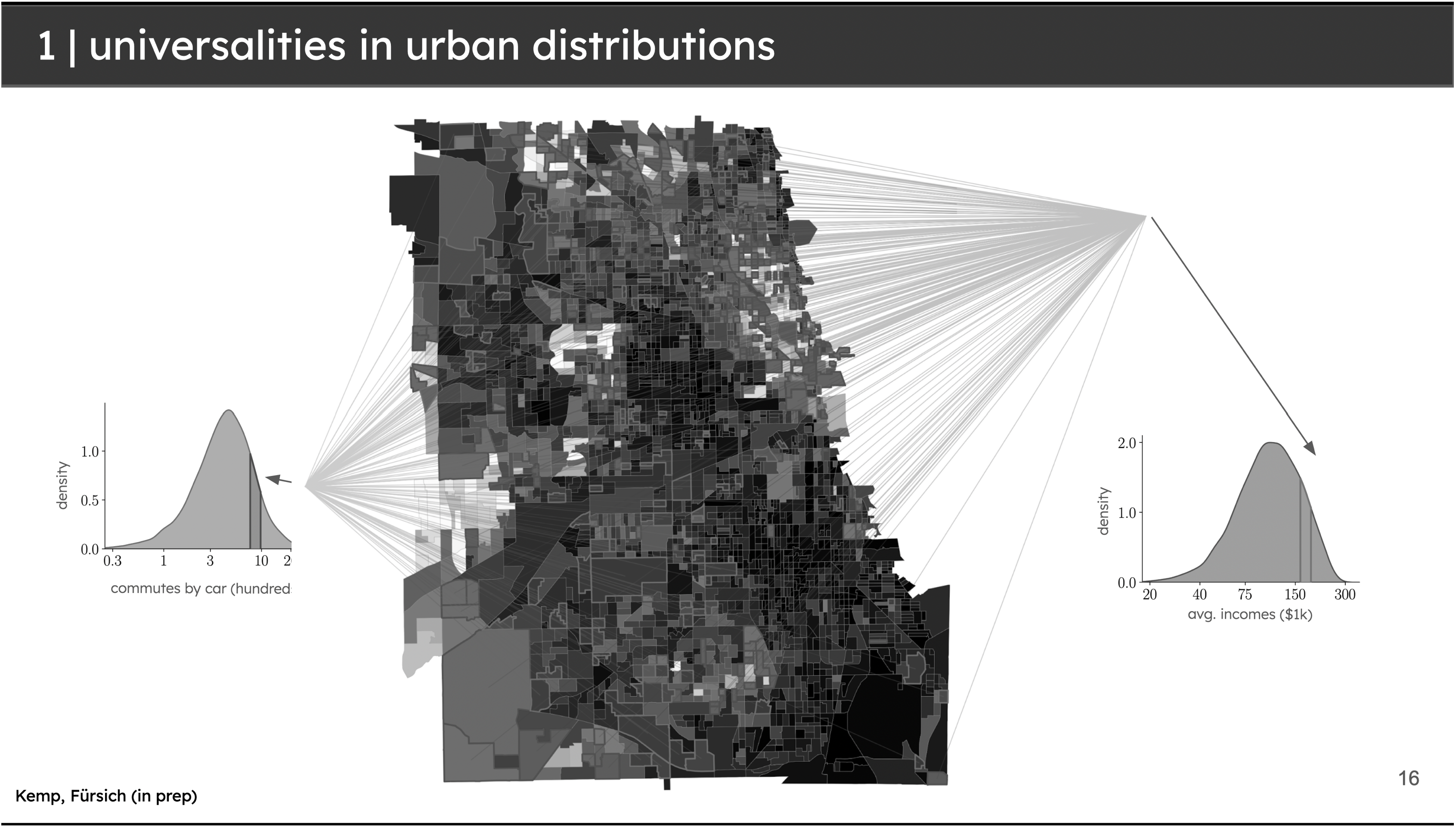
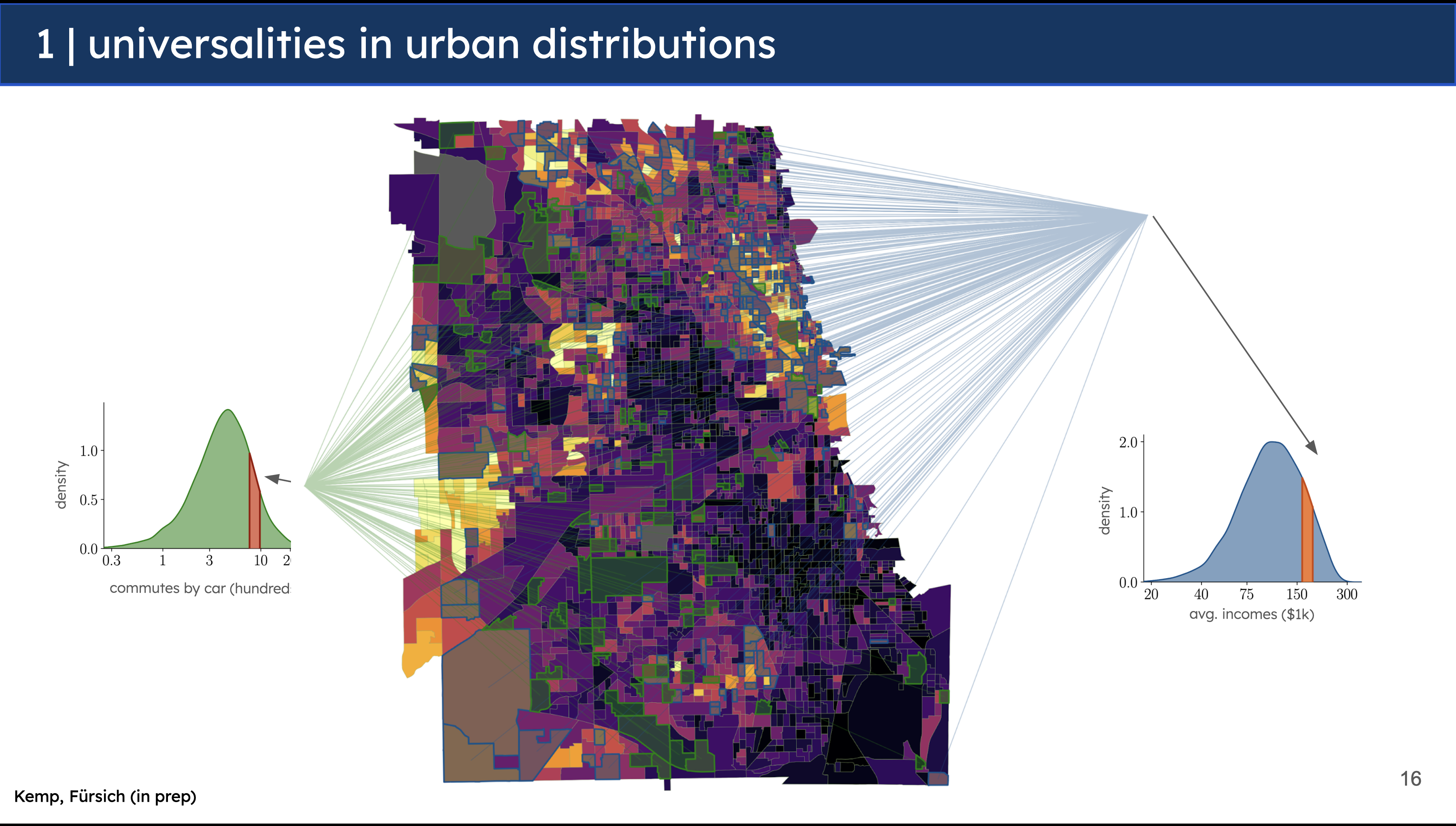
Growth in human societies is an inherently multiscale phenomenon, emerging from socioeconomic and demographic changes across nested spatial units. Yet standard macroeconomic indicators obscure these dynamics by averaging over heterogeneity in both place and population. This talk introduces a framework based on the Price equation that decomposes aggregate growth exactly into two components: endogenous income growth and selection effects across spatial scales. These selection effects capture how residential sorting, driven by preference and opportunity, interact with the economic structure of the city to affect aggregate growth. Using population and income data from the Chicago metropolitan area (2014–2019), we show that both growth and selection are highly localized, fat-tailed, and spatially correlated. Selection, defined as the covariance between income and population change, is concentrated in a small number of places and exhibits systematic scaling across counties. Despite intense local sorting, selection effects largely cancel in the aggregate, revealing how volatile and unequal micro-dynamics can produce stable macroeconomic trends. By treating neighborhoods as evolving subpopulations under selection, this framework furthermore connects methods from complex systems to urban sociology, providing a new way to identify processes such as gentrification and abandonment. More broadly, it offers a general approach to understanding compositional change in any nested economic system, from cities to innovation and production networks.
Intended audience: Broad technical audiences.
Spatial Relativity: Information and Selection as Distributional Measures of Urban Growth and Inequality
CUSP Seminar
Center for Urban Science and Progress, New York University
September 9, 2025
Center for Urban Science and Progress, New York University
September 9, 2025


Intended audience: Academic researchers interested in urban science, inequality, and urban sociology.
Cooperation and Inequality in Stochastic Models of Growth
CSH Lecture Series on Network Inequality
Complexity Science Hub, Vienna, Austria
February 14, 2024
Complexity Science Hub, Vienna, Austria
February 14, 2024


Intended audience: Academic researchers interested in network science, inequality, and stochastic processes.
The Statistical Mechanics of Learning and Co-Adaptation
Dissertation Defense, Department of Physics
University of Chicago
June 27, 2024
University of Chicago
June 27, 2024


Intended audience: Statistical physicists, biophysicists, and machine learning researchers.
Find me on Google Scholar and Researchgate